06. Occupations
On jobs, Keon Coleman, and the makeover of Hind's Hall.
The last time I wrote an entry for this newsletter, I was still unemployed, which is good for posting regularly but not much good for anything else. I haven’t written here since I started a new job a few weeks later1 — the first job I’ve had that feels, three years in, like an actual career.
I think I’m still dealing with the fallout from when I hoped to make creativity into a career. For years I considered my job as “just a day job,” something to earn a paycheck so I could buy PBRs at comedy theaters and pay improv coaches to show up hungover to Saturday morning rehearsals.
All the while, I always dreaded the question, “So, what do you do?” As if how I made my living was how I wanted to live my life. Here are the various identities I listed under ‘Your occupation’ on my tax forms, as far as I can find them in my records:
2016: WRITER
2017: MARKETER
2018: MARKETING PROFESSIONAL
2019: MARKETING MANAGER
2020: [none]
2021: CONTENT STRATEGIST
I think I’m getting closer to seeing my job as an occupation, as something I do to make my way in the world — and my creative life as my way to make sense of it. But I don’t really tie my identity to either of them. That’s a healthier relationship with creativity, I think. Even if it means I’m not writing newsletters as often.
Keon Coleman: America’s New Funny Man
I’m in love with the Bills’ new second-round draft pick, Keon Coleman. I can’t remember an NFL player who so quickly established himself as a genuinely funny dude.
Here’s Keon’s first day as a pro, which he spends trying to make just about everybody in the facility laugh2:
At one point during his visit, Keon puts on a pair of sterile gloves and starts riffing on the “importance” of his new job:
You think I could be a surgeon or something? I could be that important? Shit, I’d be in there like, ‘Whoa, whoa, whoa. You gotta stitch him up. I can’t do it. I resign.’
While everyone eats up the bit, Keon says something so humble it feels out of character for an NFL receiver:
See, my profession, I’m playing with people’s happiness on a Sunday.
Keon understands his occupation. He knows none of this matters, really, that his talent might be able to transform his circumstances, but it can’t change the world. He’s gotta have a killer mindset, and that’s no way to save lives.
This kid seems unusually wise for a 20-year-old on the precipice of (I hope) superstardom. At his introductory press conference, he told reporters, “Statistics say I’m not supposed to be here.”
Statistics say he’s not supposed to be good, either. All the film nerds and NFL analysts say his Yards Per Route Run are too low, that he can’t separate from defenders against press man coverage, that he profiles best as a big slot receiver and not as the X receiver the Bills desperately need him to be.
Screw all that. This dude’s got the rizz to occupy a place in Bills history. He’s my new special little guy.
Hindsight at Hind’s Hall
Many have already observed that last week’s police crackdown of the student occupation of Columbia University’s Hamilton Hall fell on the anniversary of another brutal response to another antiwar protest 56 years ago. The NYT’s account of that 1968 crackdown reads briefly like a florid novel:
They came on inexorably, a disciplined blue line of bobbing flashlights and many with nightsticks, then broke into a ragged charge. The students fell back, some tripping over low chain-link fences, and scattered like disturbed insects. There were screams, shouted obscenities and cries of “fascist pigs!”
That account also has a perfect stand-in for the centrist commentary on the protests in 2024:
“I came here for an education,” said a young man in a jacket and tie.
Columbia has been the catalyst for the student encampments across the country, but this is the first time I’m understanding the history of Hamilton Hall3 as the nucleus of student protests at Columbia. It has a history of being taken over to make a point.
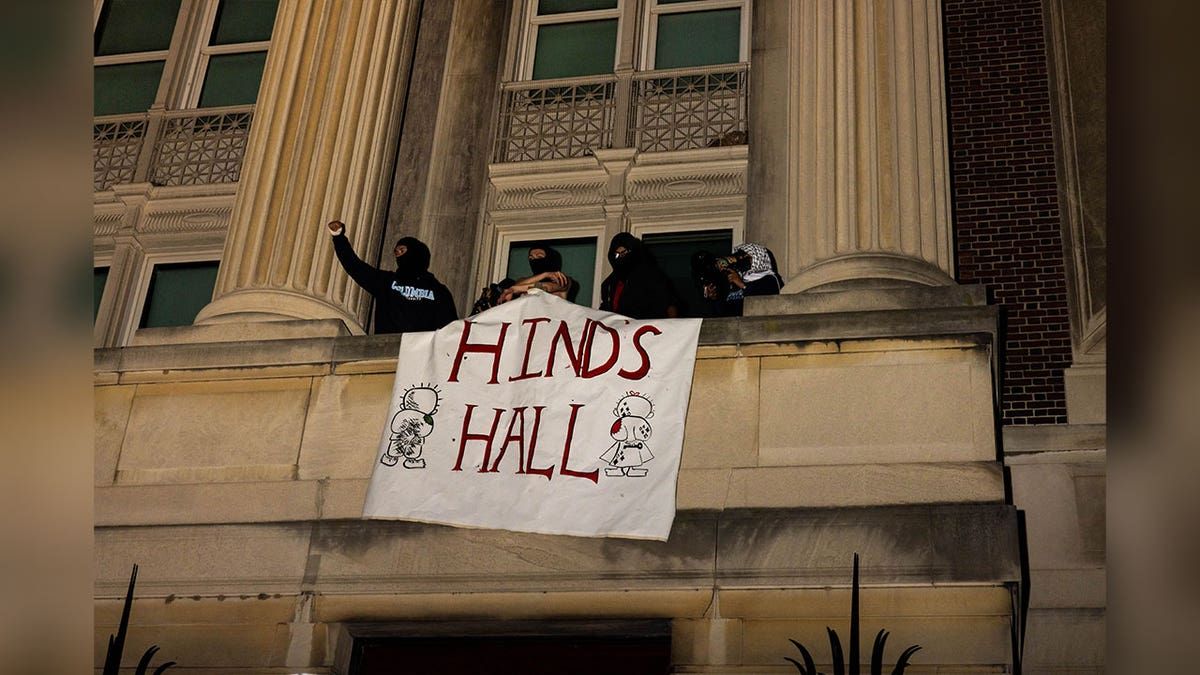
At first I wondered whether it was fair to call this newest takeover an “occupation” — it is, of course, a demonstration to oppose a real military occupation, in which the stakes are considerably higher — but that’s the term the students themselves seem to prefer. By occupying Hamilton Hall, the protestors also gave it a new name:
At around 1:40 a.m., protesters inside Hamilton unfurled a banner reading “Hind’s Hall”—renaming Hamilton after Hind Rajab, a six-year-old Palestinian killed by the Israeli military in Gaza.
When all this was going down, I found myself following the real-time reporting from the school’s radio station, WKCR, which had to defend its right to broadcast in the midst of an ongoing protest, and its campus newspaper, the Columbia Spectator. The Spectator staff later published a summary of the “day marked by suppression of free press unlike anything we’ve ever seen during our time on Spectator,” which includes plenty of details about the cops being stupid assholes:
A block away from us on Broadway and 114th Street, the NYPD argued with a pair of Spectator reporters for over half an hour about whether or not they were credentialed journalists, jeering at their makeshift press passes.
These kids are gonna win a Pulitzer. In fact, the Pulitzer Board Prize Board praised the “extraordinary real-time reporting of student journalists at Columbia University, where [we just want to point out, you know, as an aside, or maybe more of an interesting note on this unique confluence of events] the Pulitzer Prizes are housed.”
While the Spectator reported on the events from campus, The New York Times’ Ali Watkins published a short article centered on the veracity of the claim that Hind was “killed by the Israel military in Gaza.” The piece says, “It remains unclear how Hind died,” which seems like a fair enough point, if you ignore the, uh, entirety of the surrounding circumstances. But then Watkins concludes with this:
It’s not the first time that Hamilton Hall has been reclaimed and renamed by student protesters. In 1985, students calling for Columbia’s divestment in apartheid South Africa renamed the building “Mandela Hall.”
Reclaimed. Renamed. Occupied. Call it what you will. To provide context on the 1985 protests, Watkins even links back to the Spectator’s account. There they call it a “blockade.” That blockade lasted three weeks. Six months later “Columbia became the first major American university to fully divest from South Africa.”
I’m not sure it matters what you call it. What matters is the response. And we’ve already seen how that’s going.
In the meantime, these student reporters rose to the occasion. And it’s not even their jobs!
A note on Substack
I have mixed feelings about keeping this newsletter on Substack, for various reasons, but I’m settling on the position that this is a small, personal newsletter and I don’t intend to make any money from this. That still might be a bad way to look at it. If it were my job to be a big important CEO, I’d not allow Nazis to occupy my platform. That I know for sure.
Those weeks also coincided with the 2020 election and the run-up to January 6th. I’d started working on a new entry called “Insurrection,” but tbh I wasn’t having very much fun with that. ↩
All that time I spent in college studying sketch comedy, when I should’ve just entered the NFL Draft! ↩
This whole thing reminded me that after antiwar protestors took over Willard Straight Hall at my alma mater, Cornell, in 1969, the school installed a small bank branch in the entrance, with an ATM that no one ever uses, so that it would become a federal building if students ever tried to occupy it again. Rude. ↩